
On this page
What new gutters should do here
A gutter system has one job: take the water that runs off the roof and put it somewhere it cannot hurt the house. In Durham that means coping with summer cloudbursts that can drop an inch or more in an afternoon, tropical systems like Hurricane Fran and Tropical Storm Chantal, fall loads of pine needles and oak leaves, and red clay that soaks water up slowly.
Raleigh-Durham airport averages about 46 inches of precipitation a year, and the daily normals put roughly 5 inches in each of July, August and September. A system sized and pitched for that will also handle the gentler winter rain.
How a good installation is done
- Measure every run. The contractor walks the house and measures each eave, notes the roof planes and valleys feeding each run, and marks where downspouts can go without dumping water on a walk, a driveway or a neighbor.
- Check the fascia. Every board is looked at and the soft-looking ones probed. Rotten or termite-damaged wood is replaced and painted or wrapped before anything is hung.
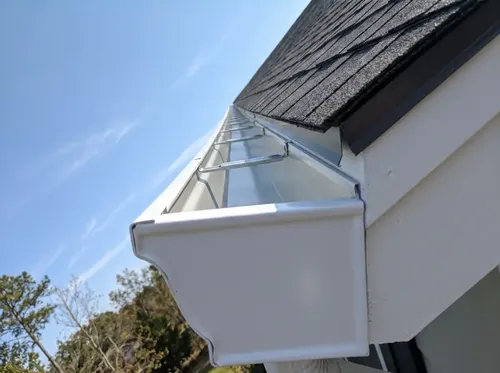
- Form the gutter on site. A seamless machine on a trailer rolls flat aluminum coil into a continuous K-style or half-round gutter, cut to the length of each run.
- Set the pitch. The gutter falls toward each outlet, usually about a quarter inch for every 10 feet. Runs over about 40 feet are pitched both ways from the middle to two downspouts.
- Hang it. Hidden hangers are screwed through the gutter into the fascia, typically every 24 inches, closer where limbs or ice are likely.
- Seal the joints. Corners are mitered and the end caps and outlets sealed. In a seamless system those are the only joints.
- Fit the downspouts. Downspouts are strapped to the wall, with elbows and extensions that carry water out and downhill.
- Run water through it. A hose at the high end of each run shows any standing water, drips or slow outlets before the crew leaves.
The parts of a gutter system
| Part | What it does | What to look for |
|---|---|---|
| Gutter trough | Collects roof water and carries it to an outlet | 5-inch or 6-inch, .027 or .032 inch aluminum |
| Hidden hanger | Holds the gutter to the fascia from inside the trough | Screws, not nails, about every 24 inches |
| Spike and ferrule | Older fastener driven through the gutter into the fascia | Tends to work loose; usually replaced with hangers |
| Miter (corner) | Joins two runs at a corner | Factory or hand-cut, sealed and riveted |
| End cap | Closes the end of a run | Sealed inside, no gaps |
| Outlet (drop) | Hole and sleeve where water leaves for the downspout | Sized to the downspout, sealed in |
| Downspout | Pipe that takes water to the ground | 2x3 inch standard, 3x4 inch for big roofs |
| Elbows | Turn the downspout around eaves and at the bottom | A, B styles; fewer bends flow better |
| Extension or splash block | Carries water away from the wall | Long enough to clear the foundation and run downhill |
| Drip edge | Metal flashing at the roof edge | Should lap into the gutter so water cannot run behind |
| Fascia | Board the gutter hangs on | Sound, painted or wrapped wood |
| Soffit | Underside of the eave | Stains or sagging point to gutter leaks above |
Materials and profiles
| Material | Typical installed price per foot | Lifespan and notes |
|---|---|---|
| Seamless aluminum, 5-inch K-style | about $9 to $13 (Angi) | 20 years or more; the standard |
| Seamless aluminum, 6-inch K-style | a few dollars a foot more (Angi) | For big roofs and steep pitches |
| Galvanized steel | about $8 to $20 (HomeGuide) | Strong against limbs; rusts once scratched |
| Copper | about $30 to $50 (HomeGuide) | Decades of life; for historic and high-end homes |
| Half-round aluminum | varies | Traditional look; carries less than K-style of the same width |
Prices are national ranges from published guides, not quotes. Height, access, fascia repair and the number of corners and downspouts move the real figure. Try the cost estimator or the Durham cost guide.
Sizing for the roof, not the house
A house's square footage says little about gutter size. What matters is how much roof drains into each run, how steep that roof is, and whether a valley pours a concentrated stream into one corner. A 1,600 square foot ranch in Parkwood with a low-slope roof and short eaves may be fine on 5-inch gutters and 2x3 downspouts. A two-story house of the same floor area near Southpoint with a 10/12 roof, long eaves and two valleys over the front porch can overwhelm a 5-inch gutter in a July storm.
The fix is usually one of three things: a 6-inch gutter on the worst runs, 3x4 downspouts instead of 2x3, or an extra downspout to cut the length each gutter has to carry. See 6-inch gutters and 5-inch vs 6-inch.
Where the water goes
The gutter is only half the job. On Durham's clay, a downspout that dumps beside the wall keeps the crawl space damp, can move the soil under the foundation and invites termites. The North Carolina Geological Survey lists the Triassic basins and Carolina terrane that run through Durham County among the areas with more shrink-swell clay.
- Extensions: the simplest answer. Carry water several feet out and downhill.
- Buried lines: solid pipe carrying water to the yard, a swale or the curb. Test old ones with a hose before connecting new downspouts.
- Rain gardens: Durham County's rain garden manual places them at least 10 feet away and downslope of a foundation with a crawl space or basement, and 25 feet from a septic drain field.
See downspouts and downspouts, rain gardens and stormwater in Durham.
Types of installation
- Seamless gutters: the standard for most houses
- Aluminum gutters: coil thickness, colors and what to ask for
- 6-inch gutters: for big, steep or valley-heavy roofs
- Half-round gutters: for bungalows and historic houses
- Copper gutters: for historic homes and high-end builds
- Downspouts: sizing, placement and drainage
Local conditions to plan for
| Condition | Where it matters most | What to ask for |
|---|---|---|
| Summer thunderstorms | Everywhere, worst on steep two-story roofs | 6-inch gutters or 3x4 downspouts on big runs |
| Old willow oaks and water oaks | Trinity Park, Watts-Hillandale, Forest Hills | Close hanger spacing, guards that are screwed down |
| Loblolly pines | Woodcroft, Treyburn, Bahama | Micro-mesh guards, regular cleaning |
| Creek flooding and wet yards | Northgate Park, north Durham along the Eno | Downspouts carried well away from the house |
| Old fascia and termites | Mill houses in Old West Durham and East Durham | Fascia probed and replaced before hanging |
| HOA color rules | Woodcroft, Parkwood, Treyburn | Check the approved list first |
Installation day, step by step
On a typical house the crew arrives with the seamless machine on a trailer and coil in the chosen color. The old gutters come down first, along with spikes and any brackets. The fascia is checked and repaired. Then each run is formed, carried up, set to pitch, and hung. Corners are mitered and sealed, outlets cut, downspouts assembled and strapped. Finally the crew runs water through each run, cleans up, and hauls away the old gutters.
Colors and finishes
Seamless aluminum coil comes in many baked-on colors. White and almond suit most sided houses. Bronze, black and dark brown suit brick and stained wood. On a brick house, a downspout matched to the brick all but disappears. Historic houses often look best with half-round gutters and round downspouts, in painted aluminum or copper.
Installation and the rules
Replacing gutters on a house is ordinary maintenance. North Carolina's building permit statute, G.S. 160D-1110, generally exempts repair and replacement work costing $15,000 or less on a single-family house unless it involves load-bearing structure, and gutter work rarely comes close. North Carolina also has no separate license for gutter installers; the state only licenses general contractors on projects of $40,000 or more. That puts the checking on you: ask for proof of insurance, three written estimates and a written contract, as the NC Department of Justice recommends.
If you live in a local historic district such as Morehead Hill or Trinity Park, ask whether exterior changes need approval before switching gutter styles or materials.