
On this page
Why downspouts matter more on red clay
Much of Durham County sits on the rocks of the Triassic basin and Carolina terrane, which the North Carolina Geological Survey identifies as areas with more expansive, shrink-swell clay. That clay takes water slowly. Water dumped at the foundation sits beside the wall, soaks the crawl space, and can make the soil under the house swell and shrink with the seasons. The NC Department of Agriculture lists grading water away from the house among the ways to fix moisture that attracts termites.
A gutter that collects water perfectly and then dumps it at the corner of the house has done half the job.
Sizes
| Downspout | Typical use | Notes |
|---|---|---|
| 2x3 inch rectangular | 5-inch gutters, modest roofs | Standard; clogs more easily with needles |
| 3x4 inch rectangular | 6-inch gutters, big roofs, valleys | Carries much more; passes debris better |
| 3-inch or 4-inch round | Half-round gutters | Traditional look |
| 4x5 inch or larger | Commercial roofs | See commercial gutters |
Placement
- At the low end of every run. Long runs get a downspout at each end, pitched from the middle.
- Away from walks, drives and doorways, where water freezes or splashes.
- Where the ground falls away from the house, if there is a choice.
- Not into a neighbor's yard. Water you send onto someone else's lot can become their problem and then yours.
- Near valleys, so concentrated flow has a short trip.
Where the water goes
| Option | How it works | Where it suits |
|---|---|---|
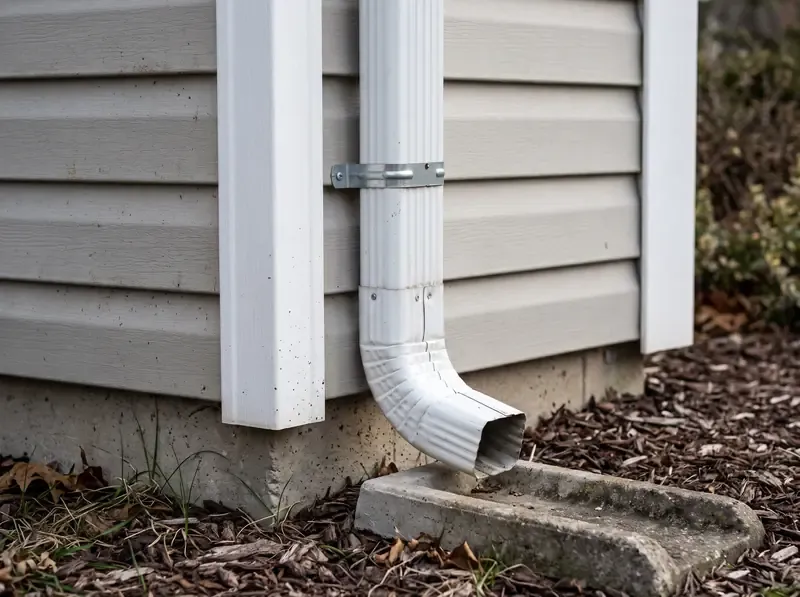
| Splash block | Concrete or plastic block under the elbow | Ground that already slopes away |
| Extension | Rigid or flip-up pipe carrying water several feet out | Most houses |
| Buried line | Solid pipe to the yard, a swale or the curb | Tight lots, patios in the way |
| Rain barrel | Stores roof water for gardens | Any house; needs an overflow |
| Rain garden | Shallow planted basin that soaks water in | Yards with room downhill |
Durham County's rain garden manual puts rain gardens at least 10 feet away and downslope of a foundation with a crawl space or basement, 25 feet from a septic drain field, and sizes them at about 10 percent of the area draining to them. The Town of Chapel Hill's rain garden sheet uses the same 10 feet from the foundation and says to call 811 before digging.
Durham's Rain Catchers work
The City of Durham developed the Rain Catchers program to put 250 small stormwater retrofits on private lots in the South Ellerbe Creek watershed, including downspout disconnections, with NC State University measuring the results. The city's public works department won an EPA Region 4 award in 2015 for the work, which showed downspout disconnection can cut runoff volume and peak flow. The lesson for homeowners: water spread onto lawn or a garden away from the house soaks in, while water piped to the street goes straight to the creek.
Buried lines
Many older Durham houses have downspouts running into clay or corrugated pipes underground. Some still work. Many are cracked, crushed or full of roots after decades. When a buried line backs up, the downspout overflows at the joint and dumps water at the foundation. Before connecting new downspouts to an old line, run a hose into it and watch the outlet. If the water does not come out, the line needs clearing or replacing.
What to ask
- How many downspouts, what size, and where?
- Where will each one discharge, and how far from the foundation?
- Will you test the buried lines before connecting to them?
- Can you route water away from walks, the driveway and the neighbor?
How many downspouts
| Gutter run | Suggested downspouts |
|---|---|
| Under 30 feet | One, at the low end |
| 30 to 40 feet | One, sometimes two under big roofs |
| Over 40 feet | Two, pitched from the middle |
| Any run under a valley | One near the valley |
| Under heavy pines | 3x4 size, or an extra outlet |
These are rules of thumb. The roof area feeding each run decides the real number.
Elbows and clogs
Every bend in a downspout slows water and catches debris. A downspout with two elbows at the top, to step out around the eave, and one at the bottom is normal. Adding extra bends to dodge a window or a bed makes clogs more likely. Where a downspout has to route around something, a larger 3x4 size makes up for the extra bends.
Extensions that stay put
Flip-up extensions are convenient by walks and beds, but only work when down. Rigid extensions pinned to the ground stay in place. Buried solid pipe carrying water to a pop-up emitter in the lawn is neat and out of the way, if the line slopes all the way and the emitter is clear of the house.
Downspout placement by Durham lot type
| Lot | Placement tip |
|---|---|
| Narrow city lot (Trinity Park, Walltown) | Route to front or back, not the side yard |
| Hillside (Morehead Hill, Hope Valley) | Carry uphill downspouts around to the downhill side |
| Creek-side (Northgate Park) | Send water toward the street, away from the low side |
| New subdivision (Southpoint, Morrisville) | Follow the builder's grading away from the house |
| Rural (Bahama, Rougemont) | Keep clear of septic fields and wells |