
On this page
- How seamless gutters are made
- Seamless vs sectional
- Why it matters in Durham
- Parts of a seamless system
- How a good seamless install is done
- Cost factors
- Repair or replace?
- Where seamless makes the biggest difference
- Checking a seamless install from the ground
- Coil, profile and color choices
- Questions to ask before you sign
- Seamless gutters across Durham's housing
How seamless gutters are made
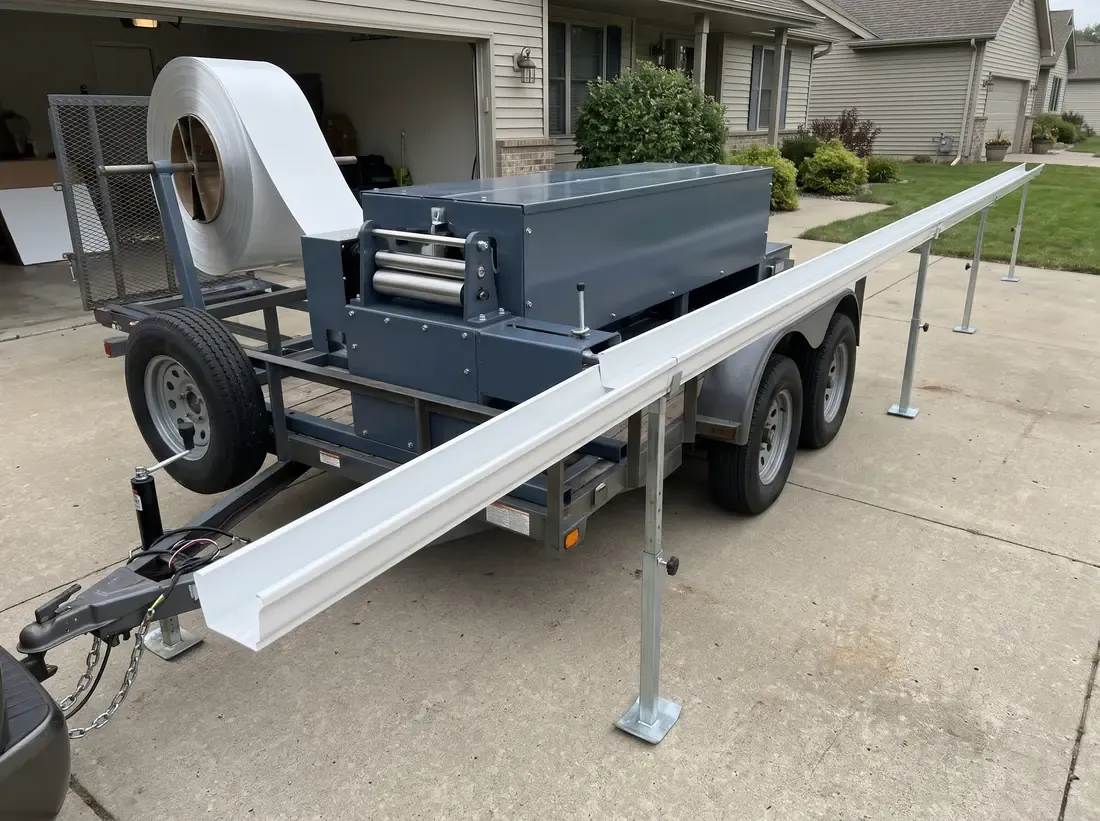
The contractor brings a roll-forming machine on a trailer and a coil of pre-painted aluminum, usually .027 or .032 inches thick. The flat coil feeds through a series of rollers that bend it into a K-style profile, and the machine pushes out a continuous gutter. The crew measures each eave, runs out that exact length, cuts it and carries it up. A 45-foot run is one piece of metal from end to end.
Seamless vs sectional
| Sectional | Seamless | |
|---|---|---|
| How it arrives | 10-foot or 20-foot lengths from a store | Formed on site to each run's length |
| Joints | One at every section, plus corners | Only corners, end caps and outlets |
| Where leaks start | Every joint as sealant ages | Corners and end caps |
| Material | Vinyl, aluminum or steel | Aluminum, steel or copper |
| Look | Visible seams along the run | Clean, continuous line |
| Who installs | Often homeowners | Contractors with a machine |
See seamless vs sectional gutters for the longer comparison.
Why it matters in Durham
Durham's rain comes in bursts. Raleigh-Durham airport averages about 46 inches a year, and the summer months bring about 5 inches each, much of it in thunderstorms. In a downpour every joint is tested at once. A sectional gutter with eight seams on the front of the house has eight chances to drip onto the siding and the foundation. On red clay that is slow to drain, those drips keep the ground beside the house wet, and the NC Department of Agriculture lists fixing exactly that kind of moisture among the ways to discourage subterranean termites.
Parts of a seamless system
| Part | Notes |
|---|---|
| Seamless run | One piece per eave, 5-inch or 6-inch K-style |
| Mitered corners | Inside and outside corners, factory or hand-cut, riveted and sealed |
| End caps | Crimped or riveted and sealed inside |
| Outlets | Cut into the bottom of the trough and sealed, sized to the downspout |
| Hidden hangers | Screwed through the front lip into the fascia, about every 24 inches |
| Downspouts | 2x3 or 3x4 inch, strapped to the wall |
How a good seamless install is done
- Each run is measured to the inch, including how far the gutter extends past the corners.
- The fascia is checked and any soft wood replaced before anything is hung.
- The gutter is formed, cut and carried up without kinking.
- Pitch is set with a string line or level, falling about a quarter inch per 10 feet toward the outlet.
- Hidden hangers go in at close spacing, closer under big trees.
- Corners are fitted, riveted and sealed, end caps sealed, outlets cut and sealed.
- Water is run through each run to check flow.
Cost factors
National guides put installed seamless aluminum at about $9 to $13 a foot for 5-inch, with 6-inch costing a few dollars more. Height, the number of corners and downspouts, fascia repair and access move the real price. Steep lots in Hope Valley or Treyburn, where ladders are harder to set, can add time. Try the estimator.
Repair or replace?
A seamless system that leaks at one or two corners or sags in one place is a repair job: reseal, rehang, done. If the metal is sound, there is no reason to replace it. If the leaks are along the run, you probably have sectional gutters, and replacing them with seamless is usually the better long-term answer. See gutter repair.
Where seamless makes the biggest difference
On older houses with original sectional gutters in Duke Park, Northgate Park and Walltown. On two-story Colonials in Woodcroft and Parkwood where long front runs collect a lot of water. And on any house where a leaking seam has already rotted a piece of fascia.
Checking a seamless install from the ground
| Check | What good looks like | What to ask about |
|---|---|---|
| Straight line along the eave | Even, slight fall toward each outlet | Dips or humps between hangers |
| Corners | Tight miters, no daylight, neat sealant | Gaps, smeared sealant on the outside |
| Hanger heads | Barely visible on the front lip, evenly spaced | Spikes, or hangers far apart |
| Downspouts | Strapped top, middle and bottom | Loose or leaning sections |
| Extensions | Carrying water several feet out and downhill | Water dumping at the wall |
| Drip edge | Lapping into the gutter | Gap between roof edge and gutter |
Coil, profile and color choices
Most seamless K-style in Durham is .027 or .032 inch aluminum. The heavier coil costs a little more and resists dents from ladders and small limbs better. Under the aging oaks of the west side or the pines of south and north Durham, it is worth asking for. Colors are baked on at the factory; white, almond, bronze and black are the common choices.
Questions to ask before you sign
- What coil thickness and size are you quoting?
- How will you set the pitch, and where will each outlet go?
- How many corners, and how will you seal them?
- Hidden hangers at what spacing?
- Will you replace soft fascia first, and how is that priced?
- Is removal and haul-away of the old gutters included?
Seamless gutters across Durham's housing
| Area | What seamless replaces | Note |
|---|---|---|
| Old West Durham, East Durham | Patched sectional gutters on mill houses | Fix the fascia first |
| Northgate Park, Walltown | 1940s and 1950s sectional systems | Add downspouts on low sides |
| Parkwood | 1960s originals or second sets | Split-level roof-to-roof fixes |
| Woodcroft | 1980s systems with spikes | Guards under pines |
| Southpoint, Brier Creek | Builder 5-inch, often already seamless | Upsize at valleys |