
On this page
When 5 inches is not enough
Durham's summer storms are short and heavy. The daily normals for Raleigh-Durham airport put about 5 inches of rain in each of July, August and September, and much of that comes in thunderstorms that drop an inch or more in an hour. Tropical systems bring more: Chantal soaked the central Piedmont in July 2025.
A 5-inch gutter on a short, low-slope eave copes fine. On a steep two-story roof the water arrives faster than the gutter and downspout can carry it, and it sheets over the front edge.
Signs you need a bigger system
- Water pours over the front of a clean gutter in heavy rain.
- Overflow is worst at an inside corner where a valley meets the gutter.
- The downspout gushes at the top elbow but the gutter still overflows.
- Mulch is washed out in a line under the drip edge.
- Paint is peeling on the fascia under one run but not the others.
5-inch vs 6-inch
| 5-inch K-style | 6-inch K-style | |
|---|---|---|
| Typical downspout | 2x3 inch | 3x4 inch |
| Best for | Single-story, modest roof planes | Steep, two-story, long runs, valleys |
| Weight when full | Lighter | Heavier; needs sound fascia |
| Clogging | Downspouts clog more easily | Larger downspouts pass debris better |
| Price | Base | A few dollars a foot more (Angi) |
What really drives the size
Three things decide the size, more than the square footage of the house.
- Roof area draining to the run. A long eave catches the water from a big roof plane.
- Roof pitch. Steep roofs shed water faster, so more arrives at the gutter at once.
- Valleys. Where two roof planes meet, a valley concentrates water into a narrow stream aimed at one spot.
Downspouts matter as much
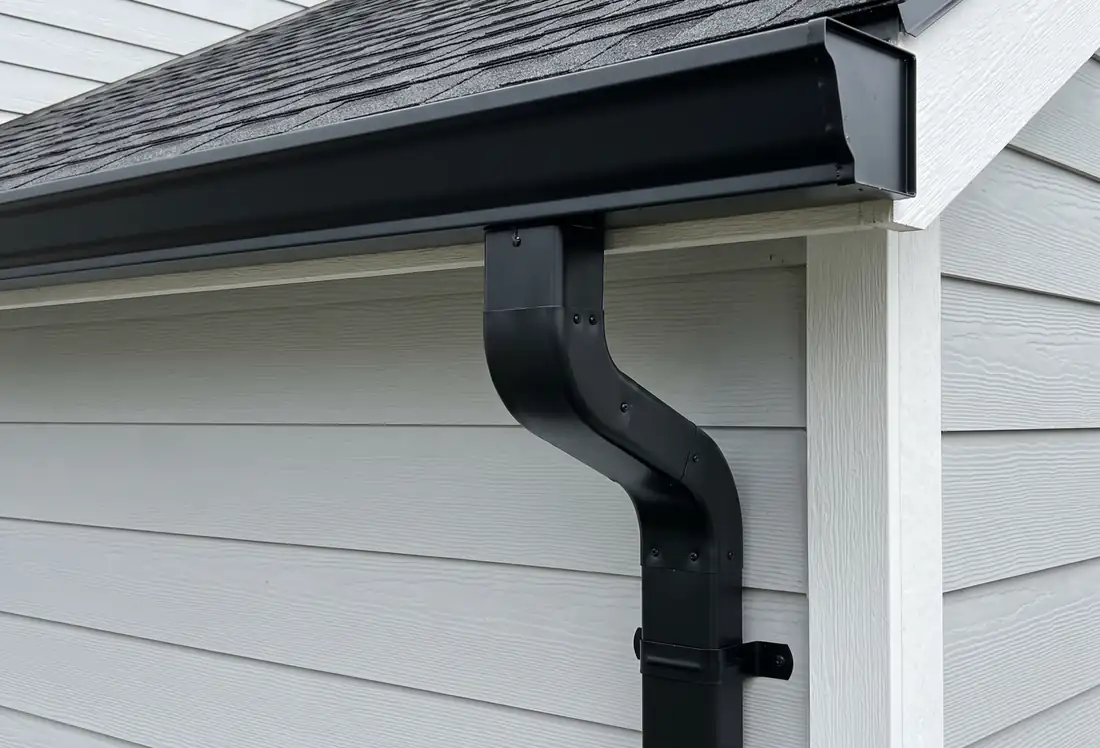
Often the quickest gain is not a bigger gutter but a bigger or extra downspout. A 3x4 downspout drains a gutter far faster than a 2x3, and it is much harder to clog with pine needles and sweetgum balls. Adding a downspout at the far end of a long run halves the distance water has to travel.
Houses that often need 6-inch
- Two-story Colonials and transitional houses near Southpoint, in Woodcroft and Brier Creek
- Steep roofs with dormers and valleys in Treyburn and Hope Valley
- Newer homes in Morrisville and Cary where the builder fitted 5-inch on large roofs
- Any run where a porch roof or valley pours in
How the switch is done
- Old gutters come down and the fascia is checked.
- 6-inch gutter is formed and hung on hidden hangers at close spacing.
- Larger outlets are cut for 3x4 downspouts.
- Where a valley meets the gutter, a splash guard or diverter may be added.
- Extensions are sized for the larger flow and run downhill away from the house.
Cost factors
The gutter costs a few dollars more per foot, the downspouts a little more again. If only some runs need 6-inch, you pay for those runs only. Fascia repair and extra downspouts are the other variables.
A worked example
A two-story house near Southpoint has a front roof plane about 40 feet long and 20 feet deep, at a steep pitch, with a valley over the porch that empties into the left-hand corner. On 5-inch gutter with one 2x3 downspout at the right end, the left corner overflows in every July storm.
Three fixes, in rising cost:
- Add a 3x4 downspout at the left corner, under the valley.
- Add a splash guard at the inside corner so the valley's stream lands in the gutter.
- Replace that run with 6-inch gutter and 3x4 downspouts at both ends.
Often the first two are enough. A contractor watching the house in a storm, or looking at the washout under the corner, can tell you which.
Choosing where 6-inch goes
| Run | Typical choice |
|---|---|
| Under a large, steep main roof | 6-inch |
| Under a valley | 6-inch or a 3x4 downspout at the valley |
| Under a short porch or bay roof | 5-inch |
| Long eave with one downspout | Add a downspout first |
| Rear of a walkout basement house | Often 6-inch; tall wall, lots of roof |
Where 6-inch comes up most
| Area | Why |
|---|---|
| Southpoint, Morrisville, Brier Creek | Steep newer roofs with valleys, builder 5-inch |
| Treyburn | Large roofs, tall walls |
| Hope Valley | Steep Tudor roofs |
| Cary newer subdivisions | Big two-story roofs |
| Mebane, Creedmoor new builds | Same builder pattern |
The cost of waiting
Overflow at the same corner, storm after storm, soaks the same section of fascia and the same patch of ground at the foundation. Over a few summers that can mean soft wood, a damp crawl space and washed-out beds. Fixing the run that overflows costs far less than fixing what it damages.