
On this page
Signs it is time
- Leaks at every seam. Sectional gutters joined every 10 feet or so leak at the joints as the sealant ages.
- Rust. Galvanized steel gutters rust from the inside once the coating wears through.
- Repeated sagging. If rehung runs keep pulling away, the fascia behind is usually rotten.
- Overflow in every storm. The gutters are too small for the roof.
- Paint peeling off the fascia and soffit along much of the house.
- Pooling by the foundation that extensions have not fixed, because the downspouts are in the wrong places.
What replacement involves
- Measure and plan. Every run is measured, downspout positions rethought for the roof and the slope of the yard, and the size chosen.
- Take down the old system. Gutters, spikes, brackets and downspouts come off.
- Repair the fascia. Rotten boards are replaced and primed or wrapped. Any termite damage is photographed and pointed out.
- Check the drip edge. If it is missing or too short, it is added so water cannot run behind the new gutter.
- Form and hang the new gutters on hidden hangers, pitched to the outlets.
- Fit downspouts and extensions to carry water out and downhill.
- Test with water, clean up and haul away.
Old system vs new
| Typical older system | Seamless replacement | |
|---|---|---|
| Joints | Every 10 feet or so | Only at corners and outlets |
| Fastening | Spikes and ferrules through the gutter | Hidden hangers screwed to the fascia |
| Size | Often 4-inch or 5-inch | 5-inch or 6-inch to suit the roof |
| Downspouts | 2x3, few of them | 2x3 or 3x4, placed for the roof |
| Material | Galvanized steel, vinyl or thin aluminum | .027 or .032 inch aluminum, steel or copper |
| Drip edge | Often missing | Added or extended where needed |
Cost factors
Replacement costs more than a new installation on a bare roof edge because of removal, haul-away and, often, fascia repair. National guides put installed seamless aluminum at about $9 to $13 a foot for 5-inch, with 6-inch costing more, and add roughly $1 to $3 a foot for a second story. Fascia replacement, extra downspouts, buried drain lines and steep lots add to that. Ask for each item to be listed separately. Try the estimator for a rough range.
Houses that need it most
Durham's older housing is where replacement comes up most. The mill houses of Old West Durham, built for Erwin Mills from the 1890s, and those around the Durham Cotton Manufacturing Company in East Durham often still have old galvanized or patched gutters on original fascia. The bungalows of Trinity Park and Duke Park are now a century old. Many 1960s ranches in Parkwood and 1980s houses in Woodcroft have original gutters that are past their best. And newer houses near Southpoint and Brier Creek sometimes have builder-grade 5-inch gutters too small for their big roofs.
Replacement and the roof
If a new roof is coming in the next few years, plan the two together. The drip edge should lap into the gutter, and setting both at once avoids a gap that lets water run behind. If the roof is staying, the contractor should take care not to lift or crack shingles when setting the new gutter.
Replacement and termites
The North Carolina Department of Agriculture lists adding rain gutters and grading water away among the fixes for moisture that attracts subterranean termites. Replacement is the time to fix a system that has been feeding a damp crawl space for years: more downspouts, longer extensions and water carried downhill. If you have a termite bond, tell the pest control company about any wood repair.
What to ask before you sign
- Will you probe the fascia, and how is wood repair priced?
- What size and coil thickness are you quoting, and why?
- How many downspouts, what size, and where will each one discharge?
- Hidden hangers at what spacing?
- Is removal and haul-away of the old gutters included?
- What is the workmanship warranty, in writing?
See repair or replace? and what gutters cost in Durham.
A typical replacement day
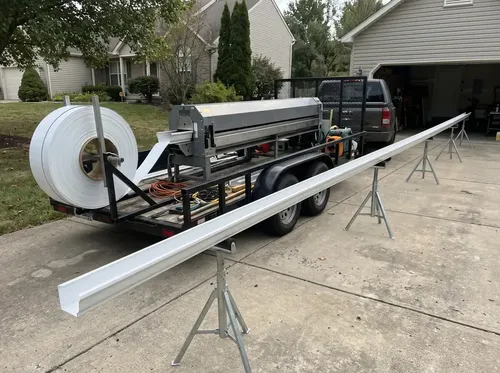
Most single-family replacements in Durham take a day. The crew arrives with the seamless machine and coil, takes down the old gutters and downspouts, and inspects the fascia. Any wood repair happens next, before the new gutters go up; on older houses that can add a day if a lot of board is soft or if rafter tails need repair. Then the new runs are formed, hung and sealed, downspouts and extensions fitted, and the system tested with water. The crew should clean up nails, sealant tubes and old metal, and haul the old gutters away.
Replacement and the yard
Replacement is also the moment to fix where water goes. Before signing, walk the house with the contractor and agree on each downspout's position and discharge. Durham County's rain garden manual uses 10 feet downslope of a crawl space or basement foundation as the minimum for soaking areas, and 25 feet from a septic field; those distances help decide where extensions and buried lines should end.
Choosing a color
Most people match the trim. On brick, a downspout matched to the brick disappears. In an HOA, check the approved list. In a local historic district, ask whether a change of color or profile needs review.